AC Freezing Up With Ice on the Lines? Why and What to Do
August 29, 2026
Quick Answer: Ice on your air conditioner's refrigerant lines or indoor coil almost always comes down to one of two problems: not enough air moving across the evaporator coil, or not enough refrigerant circulating through it. A dirty filter, blocked vents, a grimy coil, a struggling blower motor, or a refrigerant leak can each drop the coil's surface below freezing, and once ice starts forming it blocks more airflow and spreads fast. Shut the system off, switch the fan to run on its own, let everything thaw all the way, and find the actual cause before you run it again. Keep the system cycling while it's iced over and you risk sending liquid refrigerant into the compressor — the single most expensive part in the whole unit.
You duck down to check the outdoor unit, or maybe you catch it out of the corner of your eye walking past the air handler, and instead of the usual quiet hum you find frost climbing the copper lines or a solid sheet of ice covering the coil. The house feels warmer than it should. The vents barely move air. Turning the thermostat down another few degrees doesn't change a thing. It's a strange sight on a hot Ohio Valley afternoon — ice forming on a machine that's supposed to be fighting heat, not making more of it. But a frozen AC is one of the most common calls a technician gets once the humidity settles in over Evansville and the Tri-State, and the pattern behind it is well understood.
Why Ice Forms on a System Built to Cool, Not Freeze
Your air conditioner moves refrigerant through the indoor evaporator coil, where it pulls heat out of the air passing over it. Under normal conditions that coil runs cold, somewhere around 40 degrees Fahrenheit — cold enough to strip heat and moisture out of the air without dropping below freezing. Two things hold it in that range: a steady flow of warm household air across the coil, and the right amount of refrigerant moving at the right pressure.
Knock either of those out of balance and the coil temperature drops below 32 degrees. The moisture that would normally condense and drain away freezes onto the metal instead. That first layer of frost blocks more airflow, which drops the temperature further, which grows the ice faster. Left alone, a light frost pattern can turn into a solid block covering the coil and creeping down the refrigerant lines within a few hours — especially in the muggy, moisture-loaded air of an Evansville summer, where there's never a shortage of humidity to freeze.
Restricted Airflow Is the Most Common Trigger
More often than any other single cause, a frozen coil traces back to something blocking the air that should be moving across it. Starve the coil of warm airflow and it has nothing keeping its temperature up. It drifts toward freezing while doing exactly the job it's built for.
A Dirty or Clogged Air Filter
This is the single most frequent starting point. A filter caked with dust, pet hair, and pollen chokes the volume of air reaching the coil, and the coil responds by getting colder instead of pulling heat out efficiently. Most filters need changing every 30 to 90 days. Homes with pets, or heavy pollen loads in late spring, often need it closer to the 30-day mark.
Blocked or Closed Supply and Return Vents
Furniture pushed against a return grille, several closed registers in unused rooms, a door shut tight against a return path — all of it cuts the air reaching the coil. The system runs exactly as programmed, but with a fraction of the airflow it was designed around.
A Dirty Evaporator Coil
Dust that slips past a worn filter settles directly on the coil fins over time, forming an insulating layer that traps cold air right at the surface instead of letting it exchange with the room. A coil that hasn't been cleaned in years is primed to freeze the moment anything else tips the balance.
A Weak or Failing Blower Motor
Slow blower speed, a fan wheel caked with debris, a motor that's simply wearing out — any of these cut the volume of air moving past the coil even with a clean filter and open vents. This one's mechanical, not a maintenance oversight, and it usually shows up as a system that freezes again and again no matter how often you swap the filter.
TIP: If your system freezes and you haven't changed the filter recently, pull it and hold it up to a light. Can't see light through it? That's very likely the whole story right there. Swap it before assuming anything more serious is going on.
Low Refrigerant Almost Always Means a Leak
Refrigerant carries heat out of your home, and it isn't consumed the way fuel is. A system low on charge is a system with a leak somewhere in the lines, coil, or fittings, and the pressure drop that comes with low refrigerant is one of the most direct paths to a frozen coil.
When charge drops below the correct level, pressure inside the coil falls with it, and lower pressure means a colder coil surface — sometimes cold enough to freeze even with airflow that's perfectly clean. The ice often builds gradually, over several days, as the leak slowly bleeds refrigerant out rather than losing it all at once. A hissing sound near a fitting, an oily residue on the lines, cooling that's been quietly weakening over the past week or two — these all point toward a refrigerant issue rather than an airflow one.
Topping off refrigerant without finding and fixing the leak buys you a short reprieve at best. The new charge escapes through the same opening the old charge did. Locating a leak, repairing it, and recharging to the manufacturer's specified level takes gauges, leak-detection equipment, and a trained hand. It isn't a homeowner fix.
Running the AC on a Cool Night Can Freeze It Too
Ohio Valley summers swing hard between muggy, blazing afternoons and surprisingly cool overnight lows, especially in spring and early fall. Central air conditioners are built around a minimum outdoor operating temperature, usually somewhere near 60 degrees Fahrenheit, below which the system can't hold the pressure differential it needs to keep the coil above freezing.
Leave the thermostat set to Cool overnight while temperatures drop into the 50s, or run the AC during an unseasonably cool stretch, and the coil can freeze even with a spotless filter and a fully charged system. This is one of the only causes here that has nothing to do with dirt, wear, or a leak. And it resolves itself simply — don't run cooling below the manufacturer's minimum outdoor temperature, and switch to fan-only on cooler nights instead.
Signs You're Dealing With a Frozen Coil
Ice on the visible refrigerant lines outside is the obvious tell, but the freeze often starts at the indoor coil first, hidden inside the air handler or furnace cabinet. Watch for these together: the system runs constantly while the air at the vents feels weak or barely cool; airflow at the registers noticeably drops off; water puddles near the indoor unit as ice starts melting on its own; frost or solid ice shows up on the copper lines outside; a hissing sound comes from near the coil, which leans toward the refrigerant-leak version of this problem.
Any one of those alone is worth a look. Weak airflow paired with puddling near the indoor unit together is a strong signal that ice has already built up somewhere in the system.
What to Do the Moment You Spot Ice
Letting the system keep running while you hope it works through the problem is the wrong move. A frozen coil can't cool effectively in that state, and forcing it to keep cycling raises the odds of sending liquid refrigerant back to the compressor instead of vapor. The compressor isn't built to handle liquid, and that mismatch can cause serious, expensive damage.
Switch the thermostat from Cool to Off. This stops the refrigerant cycle immediately and keeps the coil from getting any colder while it starts to thaw.
Set the fan to On instead of Auto. Running the blower on its own, with cooling disengaged, pushes room-temperature air across the frozen coil and speeds the thaw up considerably compared to Auto, where the fan would otherwise sit idle between cycles.
Do not chip, scrape, or pick at the ice. Coil fins are thin aluminum, and the refrigerant lines running through them are more fragile than they look. Break ice away by hand and you risk puncturing a line or bending fins — turning a simple freeze into a refrigerant leak or an airflow problem that didn't exist before.
Pull and inspect the air filter while it thaws. Dirty, replace it. Already clean? That tells you something useful — the cause is probably refrigerant, blower, or something mechanical rather than routine maintenance.
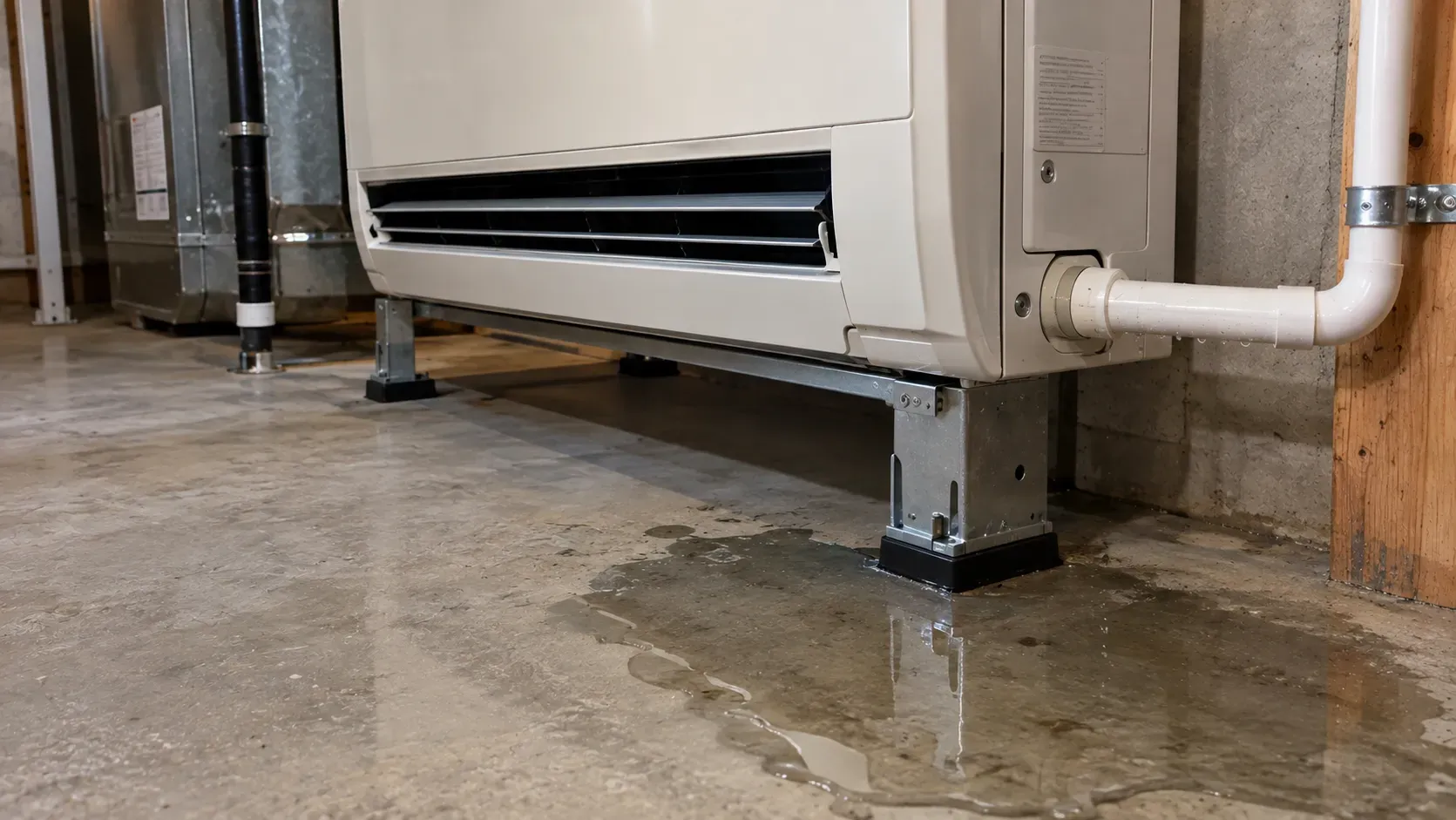
Protect the area around the indoor unit. Expect real water runoff as the ice melts. Towels or a shallow pan around the unit protect the flooring, especially if the condensate drain is also handling extra volume from the melt.
WARNING: Never switch cooling back on while any ice is still visible on the coil or lines, even if it looks nearly gone. Restart too early and you send liquid refrigerant toward a compressor built to handle vapor, not liquid — one of the fastest ways to damage or destroy it. Wait until the coil and lines are completely clear before turning cooling back on. If the freeze comes back after a fresh filter and a full thaw, leave the system off and get it looked at rather than cycling it again.
When a Fresh Filter Isn't the Fix
A frozen coil that clears up with a new filter and stays clear was probably a simple airflow problem. One that comes back within a day or two, despite a clean filter and open vents, is telling you the cause lives somewhere a filter can't reach: low refrigerant from a leak, a failing blower motor, blocked ductwork, or a coil that needs an actual cleaning rather than a filter swap. At that point, diagnosis with gauges and airflow measurements is the only reliable way to find the real fault instead of guessing at parts.
Frequently Asked Questions
Why is there ice on my AC's refrigerant lines but the coil looks fine?
Ice on the outdoor refrigerant lines can indicate a freeze that began at the indoor evaporator coil. As ice builds, it can extend through the refrigerant circuit, making the outdoor lines visibly freeze before the indoor coil does.
Can a dirty filter really cause a full-on frozen coil?
Yes. A clogged filter restricts airflow across the evaporator coil, causing its temperature to fall below freezing. Moisture then freezes on the coil instead of draining normally, eventually creating a substantial layer of ice.
Is it safe to keep running the AC if it's freezing up?
No. Continuing to operate a frozen AC can worsen the restriction and potentially send liquid refrigerant toward the compressor. Turn cooling off, run the fan, allow complete thawing, and identify the underlying problem.
How long does it take for a frozen AC coil to thaw?
A frozen AC coil typically takes several hours to thaw completely when cooling is off and the fan runs continuously. Heavier ice buildup may require additional time, so avoid scraping or chipping it.
Does low refrigerant always mean my AC needs to be replaced?
No. Low refrigerant usually indicates a leak, but replacement is not automatically necessary. Depending on the leak's location, a technician may repair the damaged component and recharge the system to the manufacturer's specifications.
Why does my AC freeze up at night but seem fine during the day?
Cooler nighttime temperatures can cause an AC system to operate outside its intended range, allowing the evaporator coil to freeze. If freezing occurs only during cool nights, fan-only operation may prevent the problem.
Preventing Frozen AC Coils and Lines in Evansville
A frozen AC coil usually means the system has lost the balance it needs to cool properly without dropping below freezing. In Evansville, IN, that can happen because of restricted airflow, a dirty coil, a weak blower motor, low refrigerant, or operation during unusually cool outdoor temperatures. Once ice begins forming, continuing to run the system only makes the restriction worse and can place unnecessary strain on critical components.
The safest response is to shut off cooling, allow the ice to thaw completely, and address the reason it froze before restarting the system. A clean filter may solve a straightforward airflow problem, but recurring ice often points to an issue that requires professional diagnosis. With 30+ years of experience, A & A Precision Heating, Cooling & Refrigeration
understands the local conditions that can contribute to frozen systems and the importance of identifying the underlying problem rather than treating the ice alone.